Finding 3
Deaths from Suicide

This image is one of thousands leaked to the press in 2019 depicting the horrific reality of the mental health crisis in Alabama prisons.
The message reads, “I’m deprest. Mental Health won’t help.”
Written in blood, the words were a plea for help by a suicidal man who had spent over half a decade in solitary confinement.
Six years later, mental healthcare in Alabama prisons remains woefully inadequate. People incarcerated in Alabama prisons are twice as likely to die by suicide compared to the state’s general population.
We know at least 44 people in Alabama prisons have taken their own lives between 2019–2024.
This data likely undercounts the true number of suicides.

Sources say some men are intentionally overdosing on drugs like fentanyl, with their deaths recorded as accidents, not suicides.
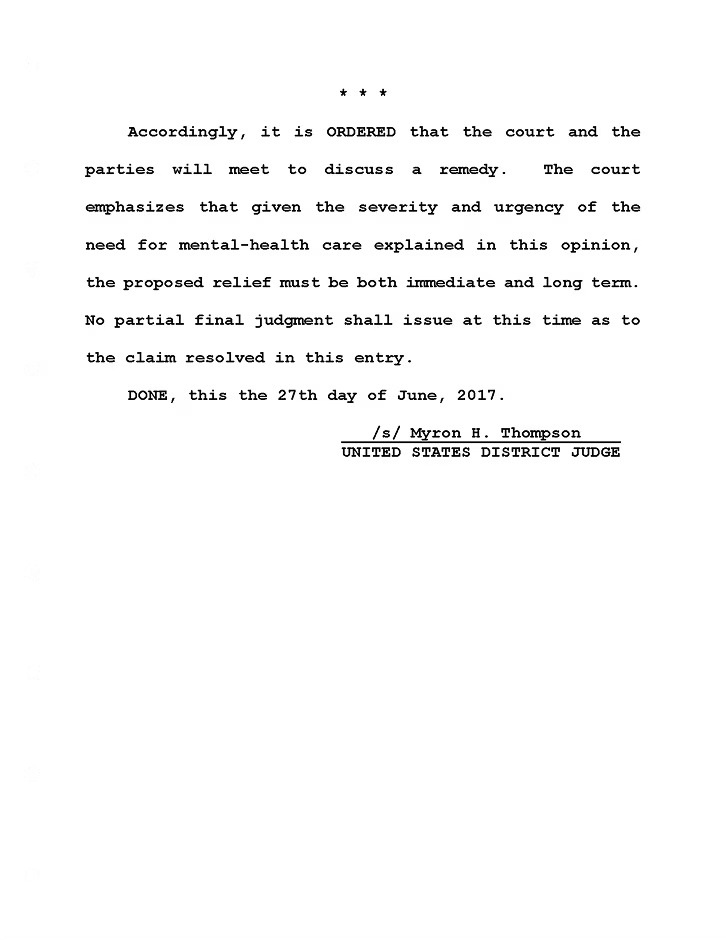
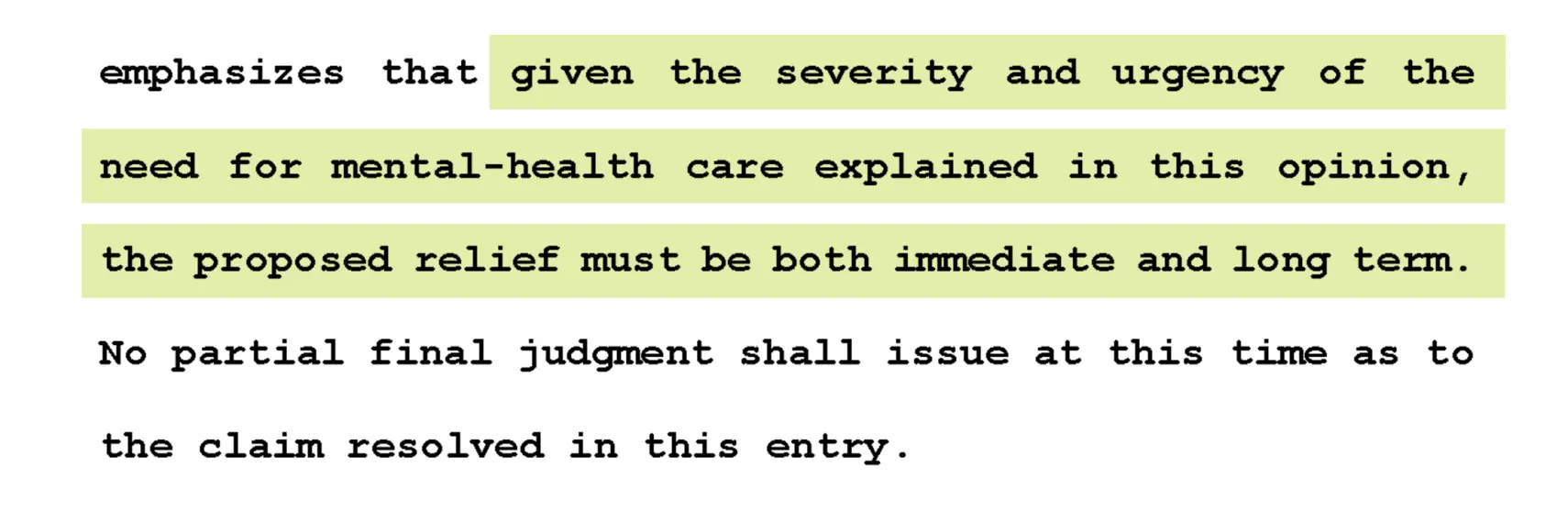
Since 2017, Alabama has been under a federal court order to improve prison mental healthcare, but incarcerated men continue to take their own lives.


Q. What do you do when you’re in your cell?
A. Ain’t nothing we can do but pace the floor.
Q. I’m sorry?
A. Ain’t nothing we can do but pace the floor.
Q. Do you have any books or —
A. I got a Bible. That’s about the only thing I got. And one book about —it’s about Jesus, but I read it so much. And I get bored. I’ll walk around the cell and I’ll rap or I may sing. Or if I had a radio, I would listen to a radio, or borrow somebody’s radio. But if you can’t borrow no radio, you ain’t got nothing to read or nothing in there.
A. ...certain officers, like Hill, will bring in a knife or razor blade and say, You want to kill yourself? Here you go. Do it with this.
Q. Officers tell you that?
A. Officer Hill. He don't give a dang at all.
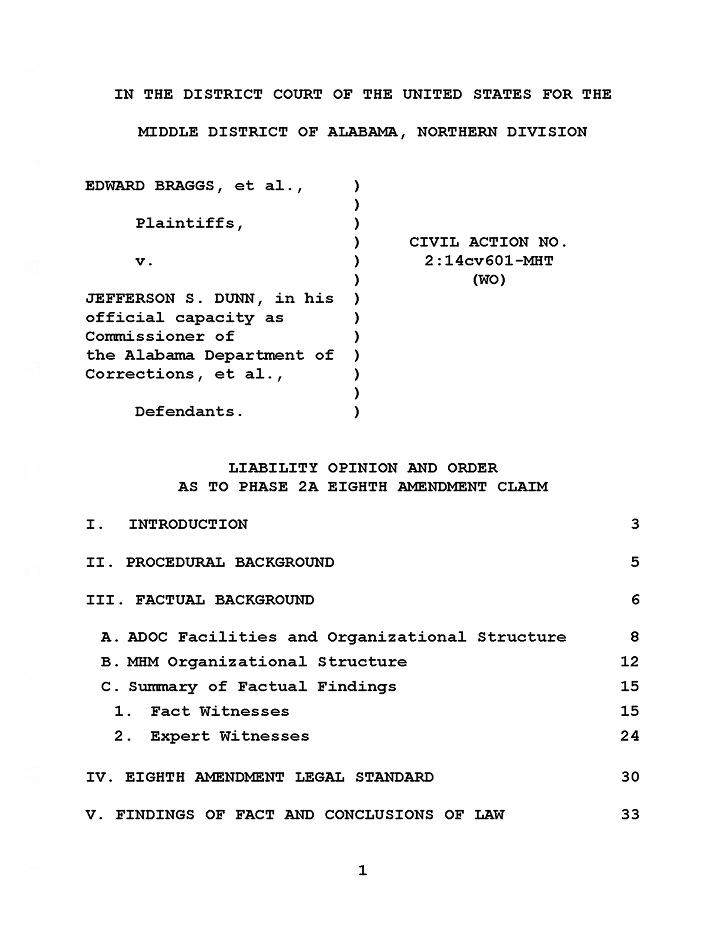
The order came from U.S. District Judge Myron Thompson in Braggs v. Dunn, a class-action lawsuit filed on behalf of incarcerated people with mental illness.
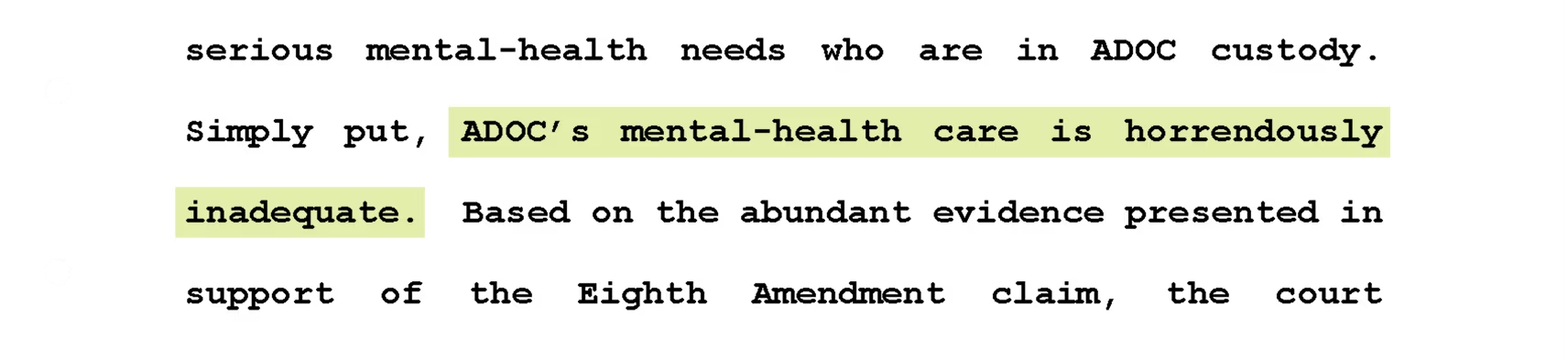
Judge Thompson found the mental healthcare in the Alabama Department of Corrections to be "horrendously inadequate."
The evidence he cited included "the skyrocketing suicide rate" in solitary confinement.
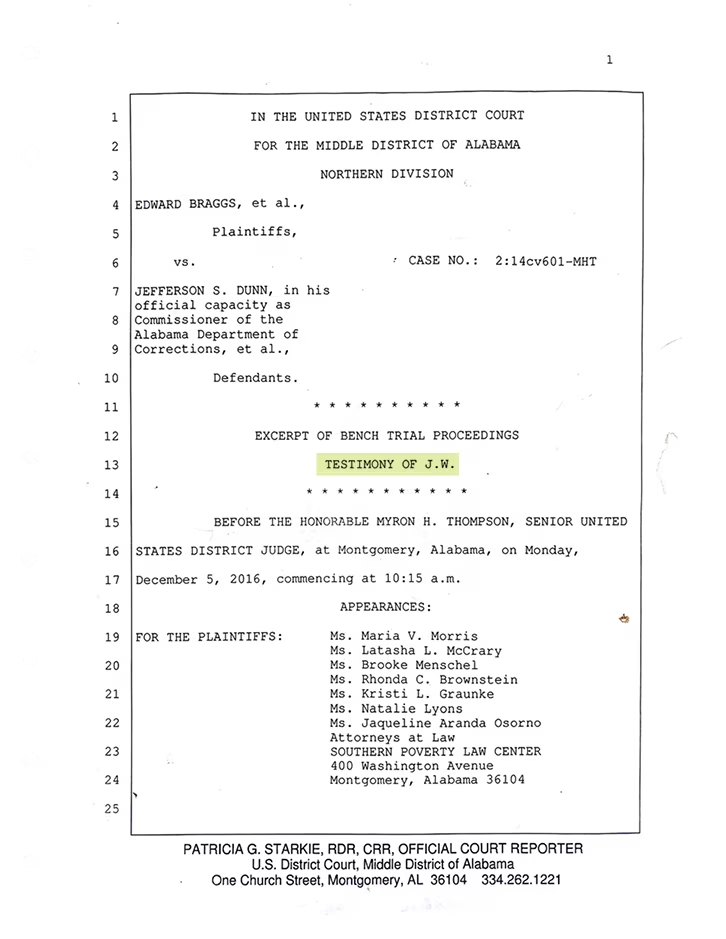
One plaintiff, Jamie Wallace, spent five years in Donaldson Correctional Facility’s “residential treatment unit,” locked in a cell alone, up to 24 hours a day.
Jamie was the first incarcerated person to testify in the Braggs trial.
Q. What do you do when you’re in your cell?
A. Ain’t nothing we can do but pace the floor.
Q. I’m sorry?
A. Ain’t nothing we can do but pace the floor.
Q. Do you have any books or —
A. I got a Bible. That’s about the only thing I got. And one book about —it’s about Jesus, but I read it so much. And I get bored. I’ll walk around the cell and I’ll rap or I may sing. Or if I had a radio, I would listen to a radio, or borrow somebody’s radio. But if you can’t borrow no radio, you ain’t got nothing to read or nothing in there.
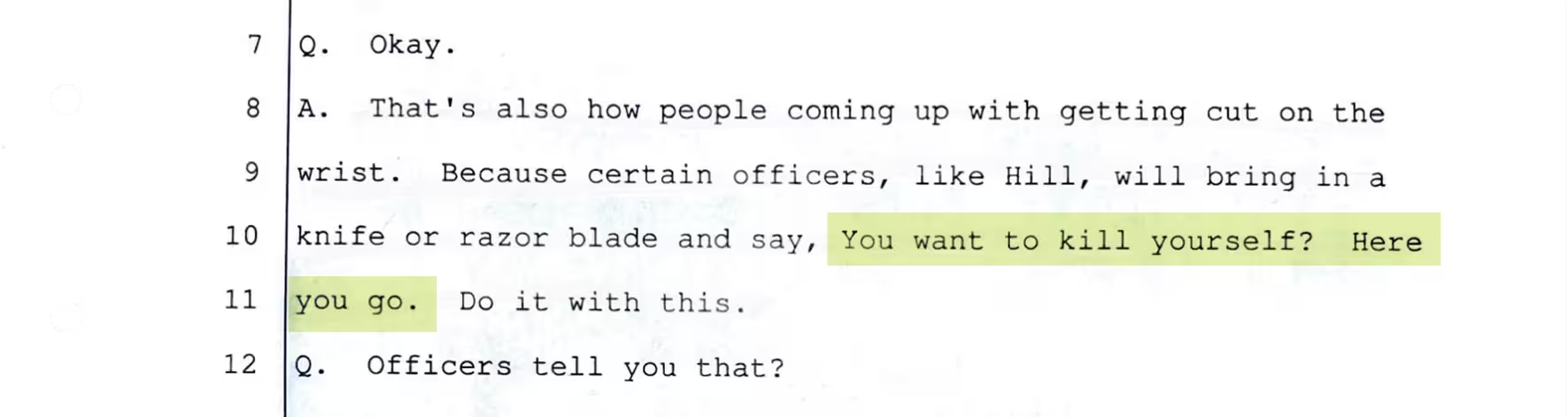
Jamie also described how one officer gave him a razor blade and encouraged him to harm himself.
A. ...certain officers, like Hill, will bring in a knife or razor blade and say, You want to kill yourself? Here you go. Do it with this.
Q. Officers tell you that?
A. Officer Hill. He don't give a dang at all.
Jamie took his own life ten days after testifying. He died by hanging himself in a cell located inside the system’s “intense stabilization unit,” where men like Jamie were supposed to get the highest level of care.
Despite a decade of federal oversight in the Braggs v. Dunn litigation, suicides reached a record high in 2023. The state continues to fight reforms ordered by the court.
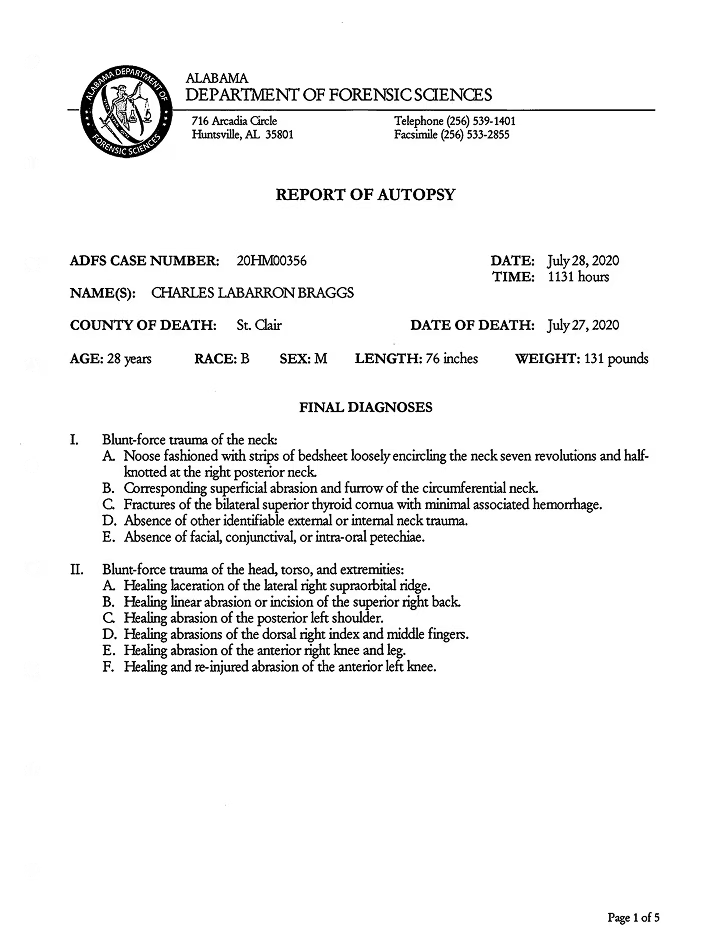
Source: Autopsy Report, Alabama Department of Forensic Sciences (2020)
CHARLES BRAGGS
1992–2020
Suicide

Charles Braggs was convicted of robbing a Pizza Hut in Mobile, Alabama. The state prosecuted him as an adult even though he was 17, and sentenced him to 20 years in prison.
Charles spent much of the next decade in solitary confinement.
In 2020, at age 28, he died by suicide after hanging himself in a segregation cell where he’d been held for two straight years.
According to court records, he received no mental health or medical care the day he died, despite his repeated requests for help.
Charles was 6 feet 3 inches tall and weighed only 131 pounds when he took his own life, 40 pounds less than when he went to prison.
His autopsy report listed many injuries in various stages of healing, as well as methamphetamine in his system.
Source: Autopsy Report, Alabama Department of Forensic Sciences (2020)
His mother, Celestine George, said her son had a good heart and was loved by his family.
“He made some mistakes when he was young, but in the end he paid with his life. I hold the prison responsible for his death.”
Charles Braggs was the seventh person to die by suicide in the year following the federal court order requiring the Alabama Department of Corrections to implement emergency suicide prevention measures.
According to court records, he received no mental health or medical care the day he died, despite his repeated requests for help.
His autopsy report listed many injuries in various stages of healing, as well as methamphetamine in his system.
Since his death, more than 35 people have died by suicide in Alabama prisons.
